Merge SourcesClean DataBuilt forBibliometrics

Bring records from Web of Science, Scopus, CNKI, and other sources into one local library. Before visualization, BibNexus handles multi-source data standardization and removes format conflicts, duplicate records, and large volumes of irrelevant noise.
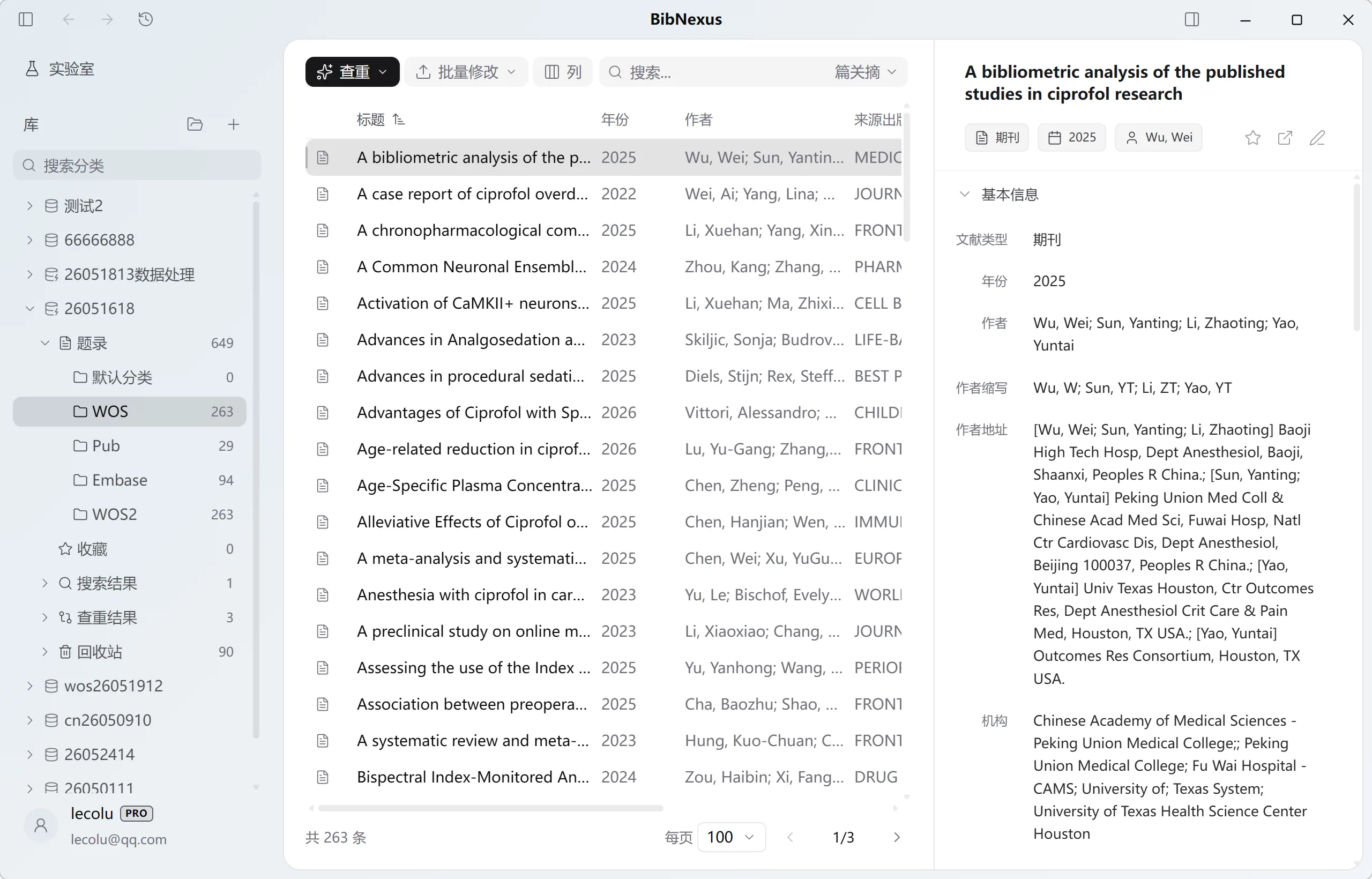
Bibliographic record management screenshot

Connect major bibliographic databases and analysis tools

Web of Science
Scopus
PubMed
Embase
Google Scholar
CNKI
Wanfang Data
VIP Journals
EndNote
Zotero
Medical Literature King
Web of Science
Scopus
PubMed
Embase
Google Scholar
CNKI
Wanfang Data
VIP Journals
EndNote
Zotero
Medical Literature King

Why Choose BibNexus

A focused preprocessing workspace that makes bibliometric data cleaning predictable.

General Reference Managers

  • Search exports often contain large amounts of irrelevant noise that general tools cannot remove at scale.
  • When Chinese and international records are merged, citation fields are easy to lose.
  • Institution and address fields stay unstructured, which distorts collaboration networks.
  • Mechanical deduplication can delete valid records or count the same paper twice.

BibNexus Preprocessing Workspace

  • A three-column workspace supports large datasets, multi-field search, and review marks before analysis.
  • A unified field contract preserves citation and address data from WOS, Scopus, and other sources.
  • Chinese sources such as CNKI, Wanfang, and VIP are parsed for standardized authors and institutions.
  • Cross-database duplicate detection keeps the most complete record and protects statistical accuracy.

Noise Screening

A three-column workspace supports multi-field search and category marks, so irrelevant records can be removed before analysis.

Multi-source Standardization

BibNexus parses heterogeneous records, maps them to a unified field contract, and preserves citation and address data.

Accurate Deduplication

A multi-signal algorithm identifies heterogeneous duplicate records. Results are grouped and traceable before removal.

Ready for Analysis Tools

Export cleaned, standardized records for CiteSpace, VOSviewer, Bibliometrix, and other bibliometric analysis tools.

Why Researchers Use BibNexus

Feedback from bibliometrics researchers, library specialists, and research assistants.

Preparing tens of thousands of records from five databases used to take several days in Excel. BibNexus now finishes standardization and deduplication in one short session before export to CiteSpace.

E
Early-career faculty member
Core journal author

General reference managers often lose citation data when Chinese and international sources are merged. BibNexus solves the deeper format standardization problem and exports clean WOS-style data.

L
Library and information specialist
Research assistant

Our medical research team has strict privacy requirements. BibNexus runs locally, does not force cloud upload, and can process large record libraries offline.

C
Clinical medicine supervisor
Meta-analysis lead

CNKI, Wanfang, WOS, Scopus, and other sources are parsed and mapped in one workflow. I no longer need scattered scripts just to clean bibliographic data.

I
Information science graduate
Data analyst

The duplicate detection is practical. It keeps records with complete citations and addresses, so VOSviewer collaboration networks become much more reliable.

R
Research team member
Systematic review researcher

Preparing tens of thousands of records from five databases used to take several days in Excel. BibNexus now finishes standardization and deduplication in one short session before export to CiteSpace.

E
Early-career faculty member
Core journal author

General reference managers often lose citation data when Chinese and international sources are merged. BibNexus solves the deeper format standardization problem and exports clean WOS-style data.

L
Library and information specialist
Research assistant

Our medical research team has strict privacy requirements. BibNexus runs locally, does not force cloud upload, and can process large record libraries offline.

C
Clinical medicine supervisor
Meta-analysis lead

CNKI, Wanfang, WOS, Scopus, and other sources are parsed and mapped in one workflow. I no longer need scattered scripts just to clean bibliographic data.

I
Information science graduate
Data analyst

The duplicate detection is practical. It keeps records with complete citations and addresses, so VOSviewer collaboration networks become much more reliable.

R
Research team member
Systematic review researcher

Frequently Asked Questions

Answers covering product scope, multi-source data processing, and local privacy.

No. EndNote and Zotero are general reference managers for reading, writing, and citation insertion. BibNexus is a preprocessing workspace for bibliometrics. It focuses on multi-source merging, field standardization, and duplicate detection before analysis.
BibNexus currently supports exports from Web of Science, Scopus, PubMed, Embase, Google Scholar, EndNote, CNKI, Wanfang, VIP, Medical Literature King, and other commonly used sources. More parsers will be added as needed.
Formats such as RefWorks, CSV, and RIS look similar, but each database organizes fields differently. BibNexus uses source-specific parsers to clean and normalize heterogeneous records before bibliometric analysis.
No. BibNexus prepares clean records for these analysis tools. You can merge, clean, deduplicate, and export standardized records to CiteSpace, VOSviewer, Bibliometrix, and similar software.
No. BibNexus follows a local-first design. Each project uses an independent local record library, and import, cleaning, deduplication, and analysis run on your own computer.
BibNexus is currently free to use. You can get a subscription code by following our WeChat Official Account or through Bilibili and Xiaohongshu channels.
Current stable installers are available for Windows 10/11, macOS on Apple Silicon and Intel chips, and Linux x86_64.

Join the BibNexus Community

Discuss bibliometrics, research tooling, and academic workflows with us.

QQ Group
Download Now